Axel’s paranoid delusions about being watched
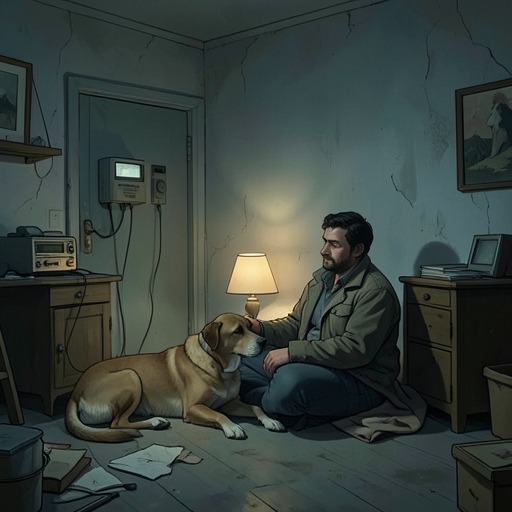
A Dog's Way HomeAxel’s paranoid delusions about being watched govern how he interprets help, technology, and even ordinary social routines. He believes unseen systems are tracking and influencing people, and he resists institutions and habits that he associates with that control. His convictions are not presented as verified facts: they appear through his repeated explanations, his refusals, and the anxiety Bella notices when he speaks. The result is a portrait of a man who seeks to remain beyond surveillance while depending, at least in part, on the presence of a dog and the concern of people around him.
Belief and Language
Axel describes his thoughts as subject to outside interference, but insists that they remain his own to command. He repeats this insistence, telling himself that the thoughts are not in charge and that he is. The refrain gives his speech the character of a struggle for authority: even as he describes an external force acting upon his mind, he asserts control over himself. His command to end the imagined transmission turns that struggle into a repeated verbal act, a way of naming the threat and attempting to stop it.
His language connects private thought to communications technology. He speaks of transmissions and later imagines medical equipment linking patients to the Internet. These ideas belong to a consistent pattern in which boundaries between the body, the mind, and remote systems seem to him vulnerable to intrusion. The narrative does not supply independent confirmation of the surveillance he fears; instead, it lets the reader encounter his certainty through what he says and through Bella’s close observation of his changing mood.
Distrust of Institutions and Assistance
When Tom suggests that Axel return to the Veterans Affairs hospital, Axel calmly refuses. He recalls that staff tried to take his blood during an earlier visit and treats that experience as a reason not to return. Tom answers that it is a hospital, but Axel reinterprets the institution itself as a place where people can be confined and monitored. He imagines patients connected to medical amplifiers that send information through the Internet, and regards the possibility of two-way transmission as evidence of danger. The exchange shows how an offer of care becomes, in Axel’s understanding, a possible route to capture and surveillance.
Tom points out that the winter in Gunnison is too severe for living outdoors, that the town lacks suitable facilities, and that Axel will not accept assistance from charities. Axel responds that those organizations all want the same thing from him. His refusal is therefore more than reluctance to enter a particular hospital: he sees the proposed sources of help as parts of a shared system whose intentions he does not trust. Tom counters by saying that people care about Axel and reminding him that he served the country. The appeal to public gratitude and practical safety does not resolve the distrust. Tom leaves the decision with Axel, while warning that he and Bella could die if they remain outside through the winter.
Surveillance in Everyday Life
Axel’s theory extends well beyond hospitals. He tells Tom that satellites are triangulating people and claims that his own unpredictable way of living keeps him outside their patterns. He also refuses genetically modified food, connecting what he eats to the same imagined network of control. His account turns apparent independence into a strategy: living at random, avoiding the grid, and rejecting particular food are, in his view, ways to evade tracking. The scene records these as Axel’s beliefs, rather than establishing that satellites or food are being used against him.
Even asking a customer’s name in a coffee shop becomes suspect to Axel when the name is entered into a computer. He sees this ordinary exchange as one among many mechanisms for tracking people. As he speaks rapidly, Bella senses his anxiety and nudges his hand to remind him that she is there. Tom then asks softly whether Axel is using again. Axel looks away and becomes furious; Bella nudges him once more, wishing he could be happy. The sequence places his conviction beside its interpersonal consequences: the conversation intensifies his distress, while Bella responds not by challenging his account but by offering physical reassurance.
Effects on Axel and Bella
Axel’s suspicion also sets limits on Bella’s contact with other dogs. At the park, she watches dogs arrive and longs to run with them. Axel allows them to approach her but does not let her follow when they run off after balls and children. He explains that the dogs are tagged and chipped, and Bella understands from his manner that she will not be allowed to play. The detail makes his fear concrete in a domestic rule: tracking devices, which he associates with surveillance, become a reason to keep Bella apart from potential companions.
His conduct thus holds together attachment and restriction. Axel keeps Bella with him, and her presence gives her a way to comfort him when his anxiety rises; at the same time, his convictions shape where she can go and whom she can follow. The narrative presents the relationship through these small actions rather than through a clinical explanation of Axel’s state. His repeated claims, refusal of institutional help, mistrust of routine data collection, and concern about implanted chips form a recurring pattern. That pattern matters because it makes his attempt to remain independent inseparable from isolation, and because Bella’s quiet gestures offer contact without dispelling the fears that govern his choices.